

Origins, Technical Overview, and Applications
Introduction
Email authentication protocols like SPF, DKIM, and DMARC play a critical role in maintaining secure email communications. However, these protocols often face challenges in forwarding scenarios where legitimate emails fail authentication checks due to routing changes. The Authenticated Received Chain (ARC) protocol addresses these challenges by preserving authentication results across intermediary servers. This blog explores ARC’s origins, technical details, and applications, showcasing its significance in modern email security.
The Origins of ARC
The Authenticated Received Chain (ARC) protocol was developed to address a critical gap in existing email authentication standards. It was standardized in 2019 under RFC 8617 by the Messaging, Malware, and Mobile Anti-Abuse Working Group (M3AAWG) in collaboration with the Internet Engineering Task Force (IETF). Major industry players, including Google, Microsoft, and Yahoo, played pivotal roles in its development.
Why Was ARC Needed?
Forwarding scenarios often break existing email authentication mechanisms:
- SPF Issues: Forwarding alters the sending server’s IP address, causing SPF checks to fail.
- DKIM Breakage: Forwarding servers may modify headers or content, invalidating DKIM signatures.
- DMARC Failures: Since DMARC relies on SPF or DKIM alignment, forwarding often leads to policy failures, resulting in rejected or flagged emails.
ARC was created to solve these issues by preserving the original authentication results, allowing downstream servers to make informed trust decisions.
How ARC Works
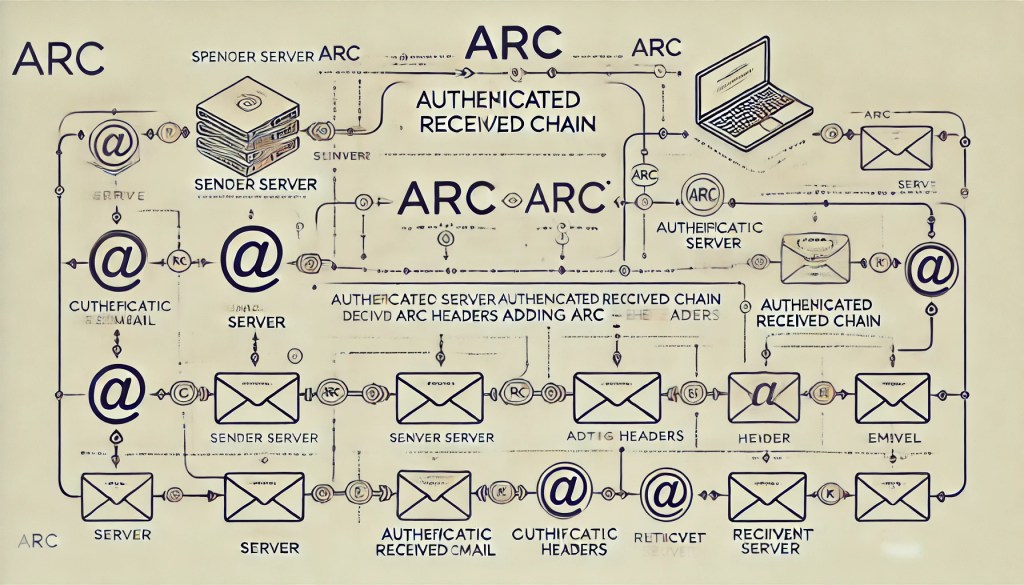
ARC introduces a chain of headers that accompany an email as it passes through multiple intermediaries. These headers preserve the authentication results and ensure their integrity.
Key ARC Components
- ARC-Authentication-Results (AAR):
- Logs the results of SPF, DKIM, and DMARC checks performed by an intermediary server.
- ARC-Message-Signature (AMS):
- Cryptographically signs the email content and AAR header to ensure authenticity.
- ARC-Seal (AS):
- Signs the entire chain of ARC headers, ensuring the chain’s integrity as the email traverses multiple servers.
ARC Workflow
- Inbound Email Received:
- The intermediary server evaluates the email using SPF, DKIM, and DMARC.
- ARC Headers Added:
- ARC headers are appended to the email, recording and signing the authentication results.
- Forwarding:
- The email, along with the ARC headers, is forwarded to the next server.
- Downstream Validation:
- The recipient’s server verifies the ARC headers to confirm the original authentication results, even if SPF or DKIM fails due to forwarding.
Applications of ARC
ARC’s primary purpose is to preserve trust and authentication integrity in complex email flows. Its applications include:
1. Mailing Lists and Auto-Forwarding
ARC ensures that emails sent through mailing lists or forwarding rules retain their authentication results, improving deliverability and reducing the risk of rejection.
2. Third-Party Platforms
Many organizations use third-party platforms (e.g., CRM systems or marketing tools) to send emails on behalf of their domains. ARC helps preserve trust in such scenarios by documenting the email’s original authentication status.
3. Enhanced Spam Detection
Spam filters leverage ARC headers to make better decisions. Even when SPF or DKIM alignment is broken, valid ARC headers provide evidence that the email is legitimate, reducing false positives.
ARC in Practice
Major email providers such as Google Workspace, Microsoft 365, and Yahoo Mail have implemented ARC to enhance email security and deliverability. For example:
- Microsoft 365 Defender: Admins can enable ARC through anti-spam policies in the Defender portal, ensuring ARC sealing is applied to forwarded emails.
Benefits of ARC
- Preserves Trust: Ensures authentication integrity in forwarding scenarios.
- Reduces False Positives: Legitimate emails are less likely to be flagged as spam.
- Strengthens DMARC Compliance: ARC complements DMARC by preserving results even when SPF or DKIM fails.
Conclusion
ARC bridges a critical gap in email authentication by addressing the challenges of forwarding and relaying. Its ability to preserve authentication results across multiple hops makes it a vital component of modern email security. By adopting ARC, organizations can enhance deliverability, trust, and protection in their email communications.
For a deeper dive into the technical specifications of ARC, refer to RFC 8617 or the Microsoft Defender Documentation. If your organization frequently forwards emails, implementing ARC is a must for maintaining a seamless and secure email experience.






 ITInnovationStation
Leave a comment