
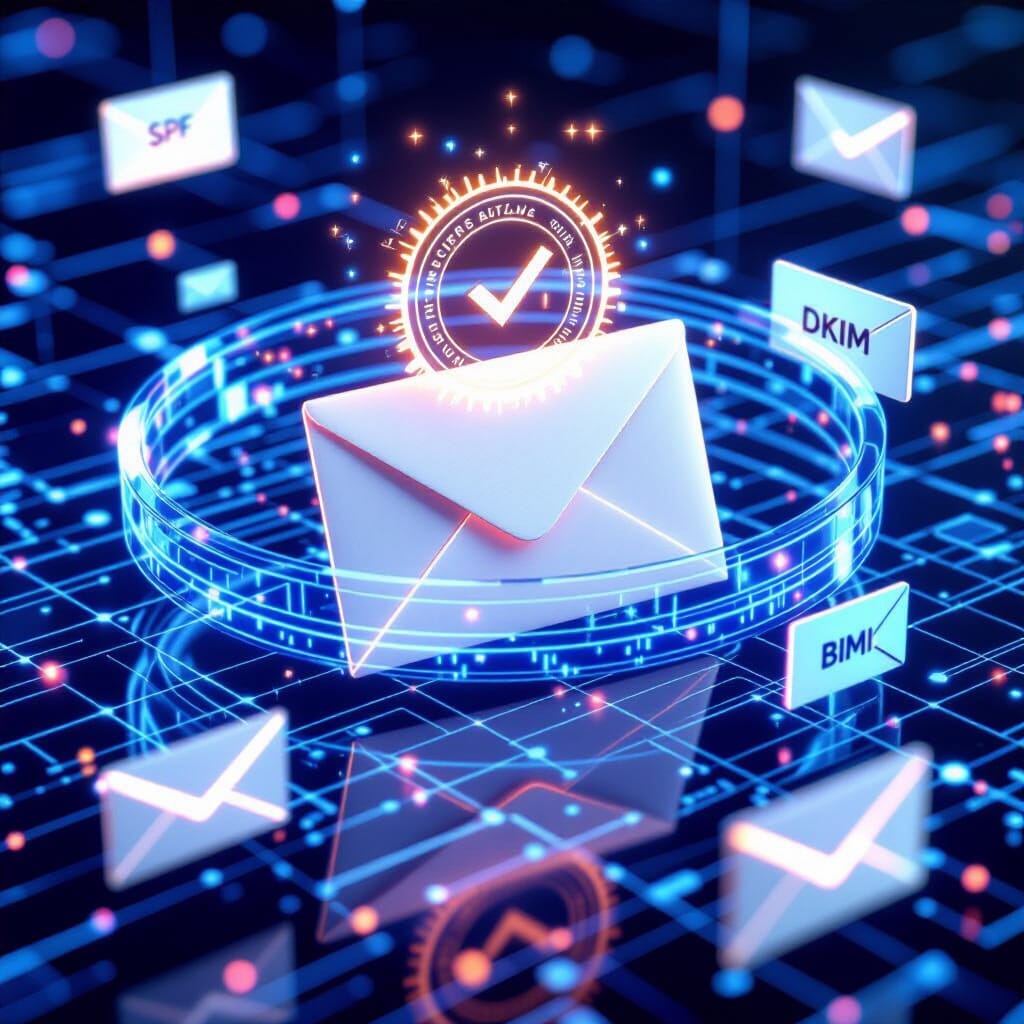
In the vast digital ecosystem, email has remained the most resilient communication medium. Despite decades of evolution, one challenge has persisted: the uncertainty of who actually sent a message. Phishing campaigns, spoofed identities, and counterfeit domains have eroded confidence in email authenticity. Yet from that turbulence emerged a new idea — BIMI, short for Brand Indicators for Message Identification.
Unlike traditional security mechanisms that work silently behind the curtain, BIMI is designed to be seen. It transforms authentication from a technical layer into a visual affirmation — a brand’s official logo displayed directly beside a verified message in the inbox. This visible cue bridges the gap between digital identity and human recognition.
1. From Silent Trust to Visible Assurance
Before BIMI, email authentication standards already existed — SPF, DKIM, and DMARC. These frameworks verified that the sender’s server was legitimate and that messages were untampered. However, they spoke only to machines.
To an ordinary recipient, every email still looked identical. A malicious imitation could pass casual scrutiny even if it failed deeper checks. BIMI shifted this paradigm by giving visual identity to authenticated mail. When properly configured, it allows a company’s verified logo to appear next to its emails in supported clients like Gmail, Yahoo Mail, Apple Mail, and Fastmail.
The psychology behind this is simple yet profound. Humans recognize symbols faster than text — a logo can instantly trigger trust where a header cannot. BIMI turns the invisible layers of authentication into something tangible, strengthening both security and brand engagement.
2. The Technical Blueprint Behind BIMI
While BIMI’s effect is visual, its foundation is purely infrastructural. At its core, BIMI relies on a TXT record in DNS, similar to other email standards.
A basic BIMI record might look like this:
default._bimi.example.com. IN TXT "v=BIMI1; l=https://example.com/logo.svg; a=https://example.com/vmc.pem"
Let’s dissect it:
- v=BIMI1 defines the version of the standard.
- l= provides the HTTPS URL to the brand’s logo in SVG Tiny PS format.
- a= points to a Verified Mark Certificate (VMC) — a digital certificate issued by an accredited authority verifying that the brand truly owns the logo.
This record acts as a public statement, much like a verified signature. The mail provider fetches the BIMI record, checks the linked resources, and validates them only after the message passes DMARC alignment with a policy of quarantine or reject. That prerequisite ensures BIMI cannot be weaponized by domains that allow unauthenticated mail.
3. The Role of DMARC in the BIMI Ecosystem
BIMI is not a standalone guardrail; it’s an enhancement to existing trust infrastructure. To display a BIMI logo, the sending domain must:
- Have SPF and/or DKIM configured and aligned.
- Publish a DMARC record with an enforcement policy of
p=quarantineorp=reject.
This requirement ensures accountability. A BIMI logo is a privilege — not a decoration. Only domains that actively reject or quarantine unauthorized mail can qualify.
In other words, BIMI rewards good security hygiene. Organizations that ignore DMARC enforcement cannot leverage BIMI’s branding benefits until they close those gaps.
4. Verified Mark Certificates: The Digital Seal of Authenticity
The introduction of the Verified Mark Certificate (VMC) added a new dimension to email identity. Much like an SSL certificate validates a website’s ownership, a VMC attests to the authenticity of a company’s logo.
VMCs are issued by certification authorities such as DigiCert and Entrust. To obtain one, the requesting organization must prove:
- Legal trademark ownership of the logo.
- Control of the sending domain.
- Completion of identity verification checks.
Once approved, the certificate binds the brand’s visual mark to its domain identity. This chain of custody makes logo impersonation nearly impossible. A fraudster might replicate a design, but without the signed VMC, mail clients will not display it through BIMI.
5. The Human Element: Why Visual Identity Matters
Humans have always relied on visual shortcuts. From ancient family crests to corporate logos, emblems have served as instant trust signals. BIMI taps into that same cognitive bias.
In crowded inboxes, users often scan sender names and icons rather than subject lines. Seeing a familiar logo next to an email subconsciously validates it. The result is a measurable increase in open rates and a decrease in accidental engagement with malicious messages.
But BIMI’s impact extends beyond marketing metrics. It represents a philosophical shift — merging cybersecurity and brand presence into a single interface. The once-hidden world of authentication now becomes part of the customer experience.
6. The Road to Adoption
BIMI began as a collaborative effort among major tech stakeholders, including Google, Yahoo, and members of the AuthIndicators Working Group. The initiative aimed to standardize a system that encouraged domain owners to implement strong email authentication by offering a visible incentive.
Adoption has grown gradually, paralleling DMARC enforcement trends. Many global brands — from banks to airlines — have already implemented BIMI, not purely for visual flair but for the added trust it signals to customers.
Still, deployment remains uneven. Some organizations hesitate due to the cost and complexity of obtaining a VMC. Others wait for broader support among mail clients. Yet the direction of progress is clear: visual trust is becoming an expectation, not an enhancement.
7. Anatomy of a BIMI Implementation
Setting up BIMI requires a precise sequence of actions:
- Authenticate the Domain:
Configure SPF and DKIM with proper alignment. - Enforce DMARC:
Ensure a DMARC record exists withp=quarantineorp=reject. - Design a Compliant Logo:
Convert the brand logo into SVG Tiny PS format — flat colors, no gradients, no embedded images. - Secure a VMC:
Apply for a Verified Mark Certificate from a trusted authority. - Publish the BIMI DNS Record:
Add the TXT record referencing the logo and certificate. - Test and Validate:
Use online BIMI checkers or tools likedigto verify the record’s visibility and format.
This sequence is both technical and procedural. Each step reinforces the next, ensuring that by the time a logo appears in someone’s inbox, it has passed multiple independent validations.
8. What Happens Behind the Scenes
When an email arrives at a BIMI-enabled service, the process unfolds silently:
- The receiving server performs SPF and DKIM checks.
- DMARC alignment is evaluated. If it passes, the server queries the domain’s BIMI record.
- The record’s logo and VMC URLs are retrieved.
- The VMC’s cryptographic chain is verified against known certificate authorities.
- If all conditions succeed, the logo is displayed beside the message.
Should any step fail — a missing DMARC policy, invalid VMC, or unreachable logo file — the logo is withheld, though the email may still be delivered. This layered approach ensures that BIMI cannot be faked or forced.
9. Security Through Incentive
Unlike most cybersecurity frameworks that rely on penalties or restrictions, BIMI motivates compliance through visibility. It doesn’t punish the unauthenticated — it rewards the verified. This subtle incentive model turns best practices into brand advantages.
Marketing departments, once indifferent to email authentication, now have a tangible reason to collaborate with IT teams. A verified logo equals higher brand recall and improved engagement. As a result, BIMI has fostered a new alliance between cybersecurity and marketing — two worlds that rarely intersect.
10. Limitations and Realities
BIMI is not a silver bullet. It cannot stop phishing emails outright, nor can it authenticate senders outside its ecosystem. Attackers can still mimic display names or use similar-looking domains.
Moreover, only a subset of mail clients currently render BIMI logos, and display policies vary. Some providers, like Apple, integrate BIMI into their broader “brand logo” frameworks, while others restrict display to verified VMC domains.
Still, even with partial adoption, the psychological and strategic value of BIMI is immense. Its visual presence reshapes how users perceive legitimacy in their inboxes.
11. The Economic Dimension of Trust
Trust has become a form of currency. Customers increasingly make decisions based on perceived authenticity, especially in financial or healthcare communications. Each spoofed message or fake invoice erodes not only user safety but brand equity.
BIMI converts invisible trust into a measurable asset. For large enterprises, a verified logo beside every outbound email reinforces their brand’s credibility hundreds of thousands of times a day. For smaller businesses, it signals professionalism — a mark of seriousness in an era where reputation often determines survival.
12. BIMI vs. Other Identity Layers
While BIMI focuses on email, it aligns with a broader industry trend toward verified digital identities. Social media platforms use blue checkmarks; browsers show padlocks; mobile systems sign apps. Each represents a visual shorthand for legitimacy.
What distinguishes BIMI is its open standard nature. It’s not owned by a single corporation. Any domain can participate by following published specifications. That openness ensures long-term resilience — a critical feature for an ecosystem as decentralized as email.
13. The Path Ahead
Future iterations of BIMI may expand its role beyond static logos. Some proposals explore dynamic verification, such as embedding cryptographic proofs directly in the logo file or linking BIMI to blockchain-based registries of brand ownership.
Others envision integrating BIMI with marketing analytics, allowing businesses to measure engagement tied to verified identity. As artificial intelligence reshapes content creation and delivery, having verifiable brand signals will become essential for distinguishing genuine communication from automated impersonation.
14. Implementing BIMI in Practice: Lessons Learned
Organizations that have successfully deployed BIMI often share similar insights:
- Prepare your infrastructure early.
Achieving DMARC enforcement can take time, especially for complex domains with multiple senders. - Work with legal and marketing teams.
Ownership verification for VMCs requires trademark documentation and brand governance coordination. - Simplify your logo.
Many corporate logos need redesigns to meet SVG Tiny PS restrictions. Minimalism is not just aesthetic—it’s a compliance necessity. - Monitor regularly.
BIMI records can fail silently if logo URLs change or certificates expire. Routine validation prevents display disruptions.
These experiences reveal that BIMI implementation is not purely a technical project—it’s organizational alignment in practice.
15. The Future Inbox: Authenticity by Design
Imagine an inbox where every legitimate sender is visually validated. No more uncertainty over which messages are genuine, no more guessing games over spoofed addresses. That is the vision driving BIMI.
When combined with DMARC enforcement, VMC certification, and evolving trust indicators, BIMI brings a new era of digital transparency. Recipients gain clarity, brands regain control, and attackers lose yet another disguise.
The standard may still be maturing, but its philosophy has already reshaped the conversation. Email authentication is no longer a background function—it’s a user-facing trust experience.
16. Why BIMI Matters More Than Ever
The timing of BIMI’s rise is not accidental. As artificial intelligence enables hyper-realistic phishing and social engineering campaigns, visual verification becomes increasingly vital. Inboxes must evolve to help humans distinguish authenticity at a glance.
BIMI’s value lies not just in displaying a logo but in what that logo represents — a verified relationship between a sender, its infrastructure, and a recognized brand identity. It’s a quiet revolution in how we perceive email, rooted in the oldest truth of design: people believe what they can see.
Final Thoughts
Email’s next chapter won’t be written solely in code or protocols but in the language of trust. BIMI transforms the inbox into a space where verification meets familiarity — where every message not only claims legitimacy but proves it visually.
In a digital world saturated with deception, that simple act — showing a verified logo beside a name — might just restore the confidence email lost years ago.






 ITInnovationStation
Leave a comment