

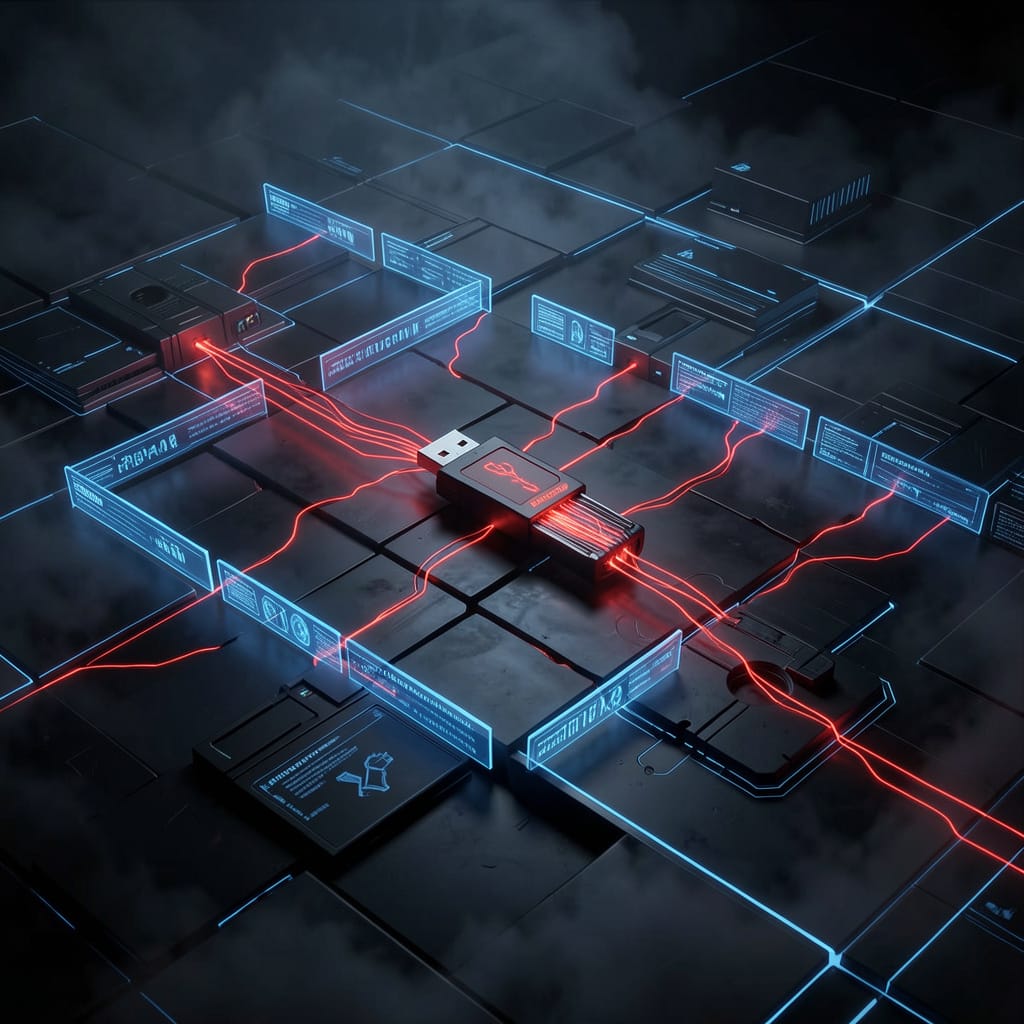
Artificial intelligence is unlocking extraordinary defensive capabilities for modern security teams, but it is also empowering attackers in ways the industry is only beginning to understand. Among the most disruptive developments is the emergence of AI-powered Cloaking-as-a-Service (CaaS)—a new class of adversarial infrastructure designed to systematically deceive AI-based security controls. If phishing kits, exploit kits, and bulletproof hosting defined past waves of cybercrime innovation, cloaking-as-a-service represents the next evolutionary step: malicious content that shifts, adapts, and disguises itself specifically for machine-driven defenses.
This blog explores what CaaS is, how it works, why it is so dangerous, and what defenders can do to prepare for an adversary that increasingly understands—and manipulates—the perception of AI systems.
1. The Rise of AI-Selective Threat Delivery
Cloaking is not a new concept. Early web-cloaking techniques delivered one version of a webpage to search engines while showing a different version to human visitors. Malware introduced anti-sandbox and anti-virtualization checks to evade automated analysis. Phishing infrastructure eventually developed user-agent filtering, geolocation restrictions, and time-based delivery controls.
What is new is the involvement of large language models, AI-powered anomaly detection systems, ML-enhanced email gateways, and AI-centric EDR decision engines. Modern enterprise defenses increasingly depend on systems that interpret risk through statistical patterns, semantic context, and behavioral correlations. This shift creates a uniquely vulnerable attack surface: AI can be deceived—not with code obfuscation alone, but with content engineered to manipulate the model’s perception.
Cloaking-as-a-service takes advantage of this by offering attackers a ready-made platform to deliver content that looks benign to AI detection tools while still enabling targeted attacks against human victims.
2. What Exactly Is AI-Powered Cloaking-as-a-Service?
AI-powered CaaS is a cloud-based malicious infrastructure platform that uses artificial intelligence to automatically rewrite, transform, and selectively deliver content in ways that evade machine-driven analysis. Rather than simply disguising malware or phishing pages, it shapes the entire experience based on who or what is requesting the content.
The platform evaluates every inbound request and determines, in real time, whether the visitor is:
- a human using a standard browser
- a cloud security crawler
- an AI-powered phishing detector
- an LLM-based email classification system
- an EDR sandbox requesting remote content
- a reputation-scoring engine performing link resolution
If the request appears automated, analytical, or model-based, the service returns clean, harmless, or misleading content. If the request comes from an actual human target, the malicious payload is served.
The result is an attack that exists only for the victim, not for the security systems evaluating the traffic.
3. The Core Mechanics Behind Cloaking-as-a-Service
CaaS platforms typically operate through a multi-layered process that combines fingerprinting, AI-based content transformation, conditional delivery, and continuous adversarial optimization.
3.1 AI-Enhanced Fingerprinting
Traditional fingerprinting checks for user-agents, headless browser signatures, virtualization clues, or network anomalies. AI-powered fingerprinting goes further by analyzing:
- behavioral timing patterns
- mouse-movement simulations
- GPU acceleration availability
- page rendering characteristics
- entropy variations in request headers
- telltale patterns of cloud security scanners
Machine learning models are trained to distinguish between human activity and AI-driven inspection. Even advanced SOC automation tools—those that “pretend” to be humans—exhibit subtle characteristics that AI can detect.
3.2 Adaptive AI-Driven Payload Shaping
Once a payload is uploaded to the platform, the service can automatically generate multiple variations:
- emails rewritten in neutral tone to avoid AI phishing scores
- HTML modified so structure appears benign under ML analysis
- JavaScript refactored to evade AI-based static scanning
- URLs and metadata re-shaped to bypass semantic risk scoring
- document lures transformed using natural language adversarial crafting
These transformations preserve the malicious function while suppressing detection triggers across a wide range of AI engines.
3.3 Conditional Behavioral Execution
Modern cloaking engines can enforce dozens of execution conditions. Some payloads only activate if:
- the visitor scrolls or clicks
- a human-like pointer movement occurs
- the device language matches the target region
- the browser supports features typical of a real workstation
- the clock drift resembles a physical host
- the network path does not originate from cloud infrastructure
Because AI analysis systems rarely meet these conditions, they see only harmless shells.
3.4 Continuous Adversarial Learning
What sets AI-powered CaaS apart from earlier generations is its feedback loop. Many services allow attackers to test their payloads across multiple AI security engines built into email gateways, endpoint platforms, and URL scanners. The platform then:
- identifies which features triggered alerts
- rewrites content to neutralize those triggers
- simulates the scoring behavior of downstream models
- generates new variations until the sample passes every AI checkpoint
This process standardizes evasion in a way previously accessible only to top-tier threat actors.
4. The Criminal Business Model Behind CaaS
Cloaking-as-a-service is appealing to attackers for the same reasons ransomware-as-a-service exploded:
- it lowers the technical barrier to advanced evasion
- it decouples infrastructure quality from attacker skill
- it operates on subscription models with tiered capabilities
- it offers pay-as-you-go functionality for phishing, malware, and fraud campaigns
Common offerings in the current underground ecosystem include:
- AI-Adaptive Phishing Kits that adjust tone, wording, and structure to avoid risk scoring
- Model-Aware URL Cloaking that blocks scanners and feeds them sanitized content
- AI-Resistant PDF and Office Document Builders that neutralize document-based AI heuristics
- EDR Cloaking Packs that reshape outbound requests to hide behavioral anomalies
- Semantic Steganography Injectors that hide malicious logic within text unlikely to be flagged by LLMs
This is adversarial tooling at industrial scale.
5. Why AI-Powered Cloaking Is So Dangerous
CaaS represents a seismic shift in the attacker-defender dynamic. Several characteristics fundamentally change the threat landscape.
5.1 It Deceives the Defenses We Rely on Most
Organizations increasingly depend on AI to filter malicious content:
- email classification
- URL reputation scoring
- contextual analysis of attachments
- automated SOAR triage
- ML-based anomaly detection
Cloaking-as-a-service directly targets these systems, producing content that appears safe specifically to them. If the AI misclassifies a threat as harmless, the entire incident response chain collapses.
5.2 It Hides Attacks from Forensic Visibility
Because the malicious payload appears only under narrow, human-driven conditions, investigators often cannot reproduce the attack. This complicates attribution, containment, and root-cause analysis. Logs and snapshots collected by automated tooling misrepresent what the victim actually saw.
Such invisibility is especially dangerous in environments that depend heavily on:
- autonomous monitoring
- AI-generated investigation summaries
- automated sandbox detonation
- machine-driven correlation workflows
5.3 It Equalizes Capability Across the Threat Landscape
Previously, only nation-state operators and high-end adversary groups could perform reliable anti-AI evasion. CaaS democratizes it. Novice hackers, ransomware affiliates, and fraud actors gain instant access to sophisticated cloaking without understanding the underlying mechanisms.
This lowers both the cost and skill threshold for launching highly evasive attacks.
5.4 It Undermines Trust in AI as a Security Mechanism
Enterprises have accelerated their adoption of AI-based detection under the assumption that AI reduces false negatives and improves triage accuracy. Cloaking-as-a-service challenges this assumption by exploiting semantic blind spots and training biases built into detection engines.
The result is a paradox: the more an organization relies on AI-only detection, the easier it becomes for AI-invisible attacks to succeed.
6. Realistic Attack Scenarios Enabled by CaaS
To understand the severity of the threat, consider several scenarios where CaaS becomes a force multiplier.
6.1 AI-Invisible Spear-Phishing
An attacker crafts a message that appears completely benign to every AI-based filter. The tone is neutral, the linguistic patterns mimic legitimate internal communication, and the embedded link resolves to a landing page that shows only harmless content when tested by automated tools. But for the targeted executive, the page serves a credential harvester.
Security controls see nothing wrong.
6.2 AI-Adaptive Malware Distribution
A malicious document is uploaded to the cloaking platform. The service rewrites metadata, modifies embedded scripts, and restructures the document so that AI-based scanners interpret it as a normal business file. Only when opened on a real workstation does the macro execute.
Automated detonation sandboxes never see the true threat.
6.3 Selective Drive-By Exploits
A cloaked webpage detects whether the visitor is a human using a real browser with active GPU rendering. If the environment matches, the exploit chain triggers. If the environment resembles an AI or automation tool, the page displays innocuous content.
The exploit appears nonexistent to the SOC.
6.4 AI-Proof Fraud, Scams, and Social Engineering
LLMs used to classify risky conversations or fraudulent emails can be deceived by adversarial phrasing, subtle tone adjustments, or semantic rearrangements generated automatically by the cloaking platform.
Human victims receive dangerous content; AI sees nothing remarkable.
7. Defending Against AI-Targeted Cloaking
Although CaaS represents a formidable threat, defenders can adapt by incorporating new strategies into their detection and analysis workflows.
7.1 Use AI, But Never Trust a Single AI Engine
Diverse detection models force attackers to evade multiple architectures simultaneously. Enterprises should combine:
- AI-based analysis
- rule-based detection
- reputation intelligence
- traditional heuristics
- human inspection
Redundancy disrupts the precision of adversarial evasion.
7.2 Perform Multi-Persona Content Retrieval
Cloaked infrastructure depends on delivering different content to different requestors. SOC tools should retrieve content using:
- human-like browser fingerprints
- AI-like request characteristics
- cloud scanner profiles
- headless browser simulations
- varied geolocations
- alternate IP reputations
Differences between responses indicate cloaking behavior.
7.3 Monitor Behavioral Consistency Across Tools
If AI rates an email as safe but heuristic scanners flag anomalies, the conflict is itself a strong signal of deception. Alerting pipelines should treat inconsistent signals as suspicious rather than accepting whichever model appears more confident.
7.4 Build Anti-Cloaking Sandboxes
Next-generation sandboxes must simulate human activity convincingly, combining:
- real timing delays
- randomized pointer movement
- unpredictable interaction sequences
- physical hardware fingerprints
This allows the malicious branch of conditional payloads to emerge.
7.5 Expand Detection to Include Adversarial Linguistics
Security tools need better coverage for:
- semantic steganography
- adversarial phrasing attacks
- token-level perturbation
- context-specific deception patterns
These are central to AI-targeted evasion.
8. The Road Ahead: An Arms Race of Perception
Cloaking-as-a-service represents a shift from evading static signatures to evading perception. AI models interpret meaning based on patterns they have learned—not on ground truth—and attackers are now crafting content that manipulates those learned patterns. Just as earlier eras saw polymorphic malware, encrypted command-and-control channels, or distributed exploit kits, the coming decade will be shaped by an arms race where visibility itself becomes adversarial.
Security programs must evolve to recognize that different agents—human and machine—experience malicious content differently. Logs, alerts, and automated analysis may no longer reflect the reality of what a victim actually encountered. The industry must adapt detection strategies that assume attackers are optimizing specifically against AI reasoning.
Cloaking-as-a-service is not just a new tool. It is a transformation in how adversaries design, deploy, and hide their operations. As AI becomes more deeply embedded in enterprise defense, attackers will target its blind spots with increasing sophistication. Understanding this shift is the first step toward building resilient defenses capable of surviving an era where the battlefield itself is shaped by artificial intelligence.
The organizations that grasp this early—and respond decisively—will set the standard for the next generation of cyber defense. Those that continue to assume their AI tools “see everything” risk becoming the first victims of attacks engineered never to be visible at all.






 ITInnovationStation
Leave a comment